Table of Contents
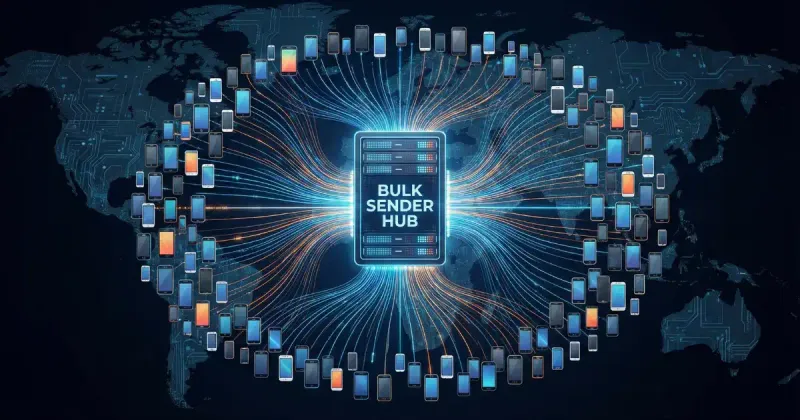
Bulk SMS refers to the dissemination of large numbers of SMS messages for delivery to mobile phone terminals. It is used by media companies, enterprises, banks, and consumer brands for a variety of purposes including entertainment, enterprise, and mobile marketing.
Unlike sending a group text from your phone, Bulk SMS relies on specialized software and SMS Gateways to handle volume, queuing, and delivery reporting.
How Bulk SMS Works
When you click “Send” on a Bulk SMS platform, your message doesn’t go directly to the phones. It follows this path:
- Application (API/Dashboard): You submit the message and list of numbers.
- SMS Gateway: The service provider validates the request (checking for funds, valid numbers).
- Aggregator: The gateway passes the message to an aggregator who has direct connections to wireless carriers.
- Carrier Network: The message enters the mobile network (Verizon, AT&T, T-Mobile, etc.).
- Handset: The message arrives on the user’s device.
This entire journey happens in milliseconds.
Key Technologies in Bulk SMS
SMS API (Application Programming Interface)
APIs allow developers to integrate SMS capabilities into their own software.
- Use Case: An Uber app sending a text when your ride arrives. The app doesn’t have a phone; it uses an API to trigger the text.
Short Codes vs. 10DLC
To send bulk messages, you need a dedicated number:
- Short Code (e.g., 12345): 5-6 digit numbers. Expensive, but highest throughput (speed). Best for massive blasts.
- 10DLC (10-Digit Long Code): Standard looking local numbers. Cheaper, good for local businesses, but stricter spam filtering.
Throughput (MPS)
Messages Per Second (MPS) is the speed limit of your sender ID.
- If you have a list of 100,000 people and a throughput of 10 MPS, it will take 10,000 seconds (~2.7 hours) to deliver all messages.
- High-volume senders need to pay for higher throughput to ensure timely delivery.

Use Cases for Bulk SMS
- Mass Alerts: School closures, weather emergencies.
- Marketing Blasts: “Black Friday starts now!”
- Competitions: “Text WIN to 55555.”
- Staff Communication: Shift reminders for 500 employees.
Compliance and Filtering
Because Bulk SMS is powerful, it is heavily policed. Carriers use AI filters to block spam. To avoid being blocked:
- Register your Brand: You must register your business (10DLC registration) to prove you are legitimate.
- Avoid Spam Words: Words like “CASH”, “LOAN”, “FREE” in all caps can trigger filters.
- Honor Opt-Outs: If someone replies STOP, your system must block them immediately.
Frequently Asked Questions
Is Bulk SMS illegal?
No, Bulk SMS is legal if you have consent. Sending bulk messages to people who did not opt-in is spam and is illegal under TCPA and GDPR.
How fast can I send Bulk SMS?
It depends on your provider and number type. Short codes can send 100+ messages per second (MPS), while 10DLC numbers are typically limited to 10-75 MPS.
What is an SMS Gateway?
An SMS Gateway is the bridge between the internet and the mobile carrier network. It allows software applications to send text messages to mobile phones.
Can I send Bulk SMS from my phone?
Technically yes, but it is a bad idea. Personal SIM cards have low limits and your number will likely be blocked for spamming. Always use a dedicated Bulk SMS service.
Related Guides
- What is SMS? - The basics of the protocol.
- What is a Short Code? - High-volume numbers explained.
- What is 10DLC? - The standard for business messaging.
WhatIsSMS.com
SMS Technology Guide